
Wireless Building Automation: A Smarter Approach to Modern Facilities
Introduction
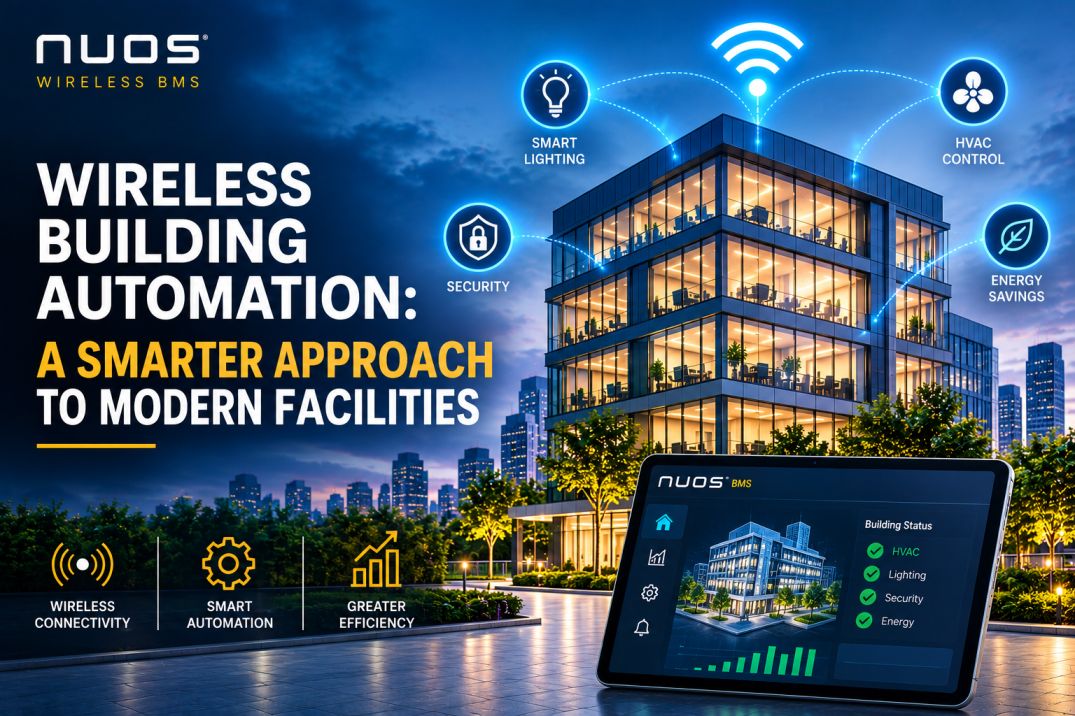
Modern facilities require building management solutions that are flexible, connected, and efficient. As organizations look for better ways to manage energy, comfort, and equipment, wireless building automation is becoming an increasingly attractive approach. NUOS BMS combines wireless connectivity with intelligent automation to support smarter facility operations.
Simplifying Building Automation
Traditional automation systems can involve extensive wiring and complex installation processes. Wireless building automation reduces dependence on physical cabling by connecting sensors and devices through wireless communication.
This can make automation easier to implement in both new and existing facilities.
Real-Time Building Insights
Smart sensors provide continuous information about building conditions. Temperature, occupancy, energy usage, air quality, and equipment performance can be monitored through a centralized BMS.
Real-time information helps facility managers understand what is happening within the building and respond more quickly to operational requirements.
Automating HVAC and Lighting
Wireless building automation can help HVAC and lighting systems respond to actual building conditions.
For example, occupancy sensors can help control lighting in unused areas, while HVAC systems can adjust according to temperature and occupancy. These automated actions can improve efficiency while supporting occupant comfort.
Improving Maintenance
Connected equipment can provide valuable performance information. A wireless BMS can identify unusual operating conditions and provide alerts to facility teams.
This supports proactive maintenance and can help reduce unexpected equipment failures and operational interruptions.
Scalable for Modern Facilities
Facilities often evolve over time. New spaces, equipment, and operational requirements may require additional automation capabilities.
Wireless systems can make expansion easier by allowing new sensors and devices to be integrated without major infrastructure changes. This scalability makes wireless building automation suitable for changing business environments.
Supporting Sustainable Operations
Energy efficiency is an important part of modern facility management. Wireless automation helps organizations monitor resource consumption and optimize building systems based on real-time conditions.
This can contribute to lower energy waste and support long-term sustainability objectives.
Conclusion
Wireless building automation offers a smarter approach to managing modern facilities. By combining connected sensors, real-time monitoring, intelligent controls, and scalable technology, NUOS BMS helps organizations create efficient, comfortable, and future-ready buildings.