
How Smart Building Sensors Improve HVAC and Energy Management
Introduction
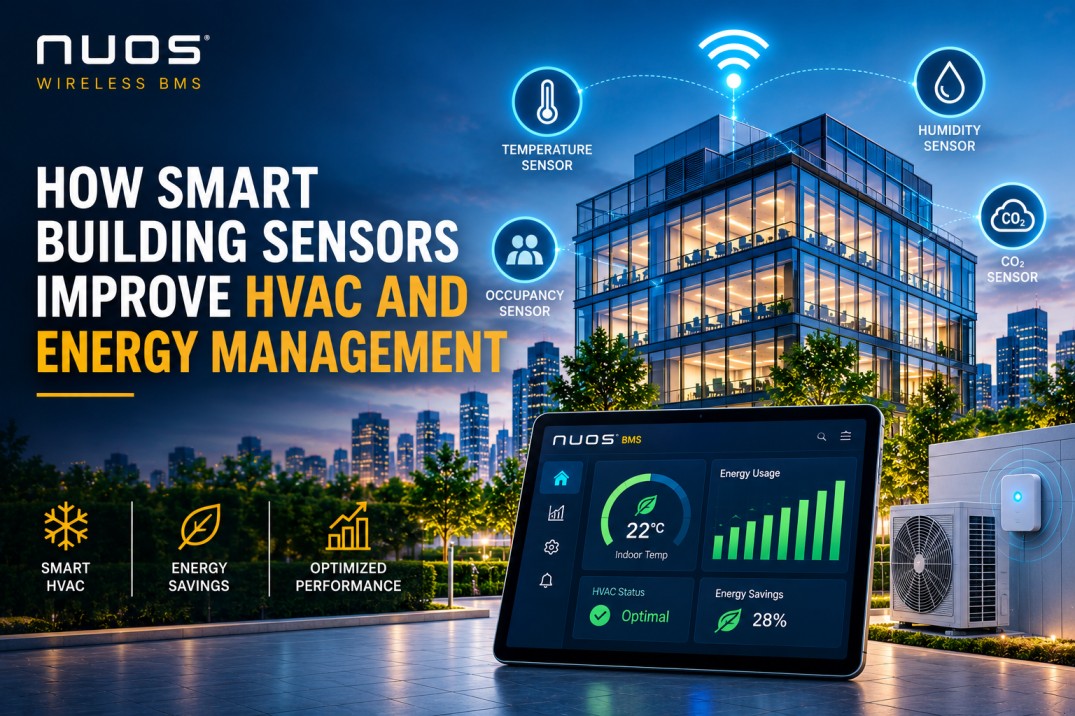
HVAC systems play a critical role in maintaining indoor comfort, but they can also represent a significant portion of a building’s energy consumption. Smart building sensors provide the information needed to operate HVAC systems more intelligently. When integrated with NUOS BMS, these sensors can support better energy management and building performance.
Monitoring Temperature and Occupancy
Smart sensors continuously collect information about indoor temperature and occupancy. This allows a BMS to understand the actual conditions within different areas of a building.
Instead of relying only on fixed schedules, HVAC systems can respond to real-time requirements.
Optimizing HVAC Performance
When occupancy changes throughout the day, HVAC requirements can change as well. Smart sensors can provide information that allows automated systems to adjust heating, cooling, and ventilation according to demand.
This can reduce unnecessary operation while helping maintain comfortable indoor conditions.
Reducing Energy Waste
Energy can be wasted when HVAC systems operate in empty rooms or maintain unnecessary temperature levels. Occupancy and environmental sensors can help identify these situations.
By connecting sensor information with automated controls, buildings can reduce avoidable energy consumption.
Supporting Indoor Comfort
Energy efficiency should not come at the expense of occupant comfort. Smart sensors provide continuous information about indoor conditions, allowing building systems to respond to changes.
This helps facility managers maintain more consistent temperature and environmental conditions throughout different areas.
Identifying Equipment Issues
Sensors can also support equipment monitoring. Unexpected changes in temperature or operating conditions may indicate that HVAC equipment requires inspection.
Early identification of unusual performance can help maintenance teams address issues before they become larger problems.
Data-Driven Energy Management
The information collected by smart sensors can help organizations understand energy usage patterns. Facility managers can use this data to identify inefficient areas and develop better operating strategies.
Over time, data-driven management can support both cost control and sustainability initiatives.
Conclusion
Smart building sensors provide the data needed for intelligent HVAC and energy management. By connecting sensors with a centralized wireless BMS, NUOS BMS helps businesses improve comfort, reduce energy waste, and manage building systems more efficiently.