
How Wireless BMS Improves Energy Efficiency in Smart Buildings
Introduction
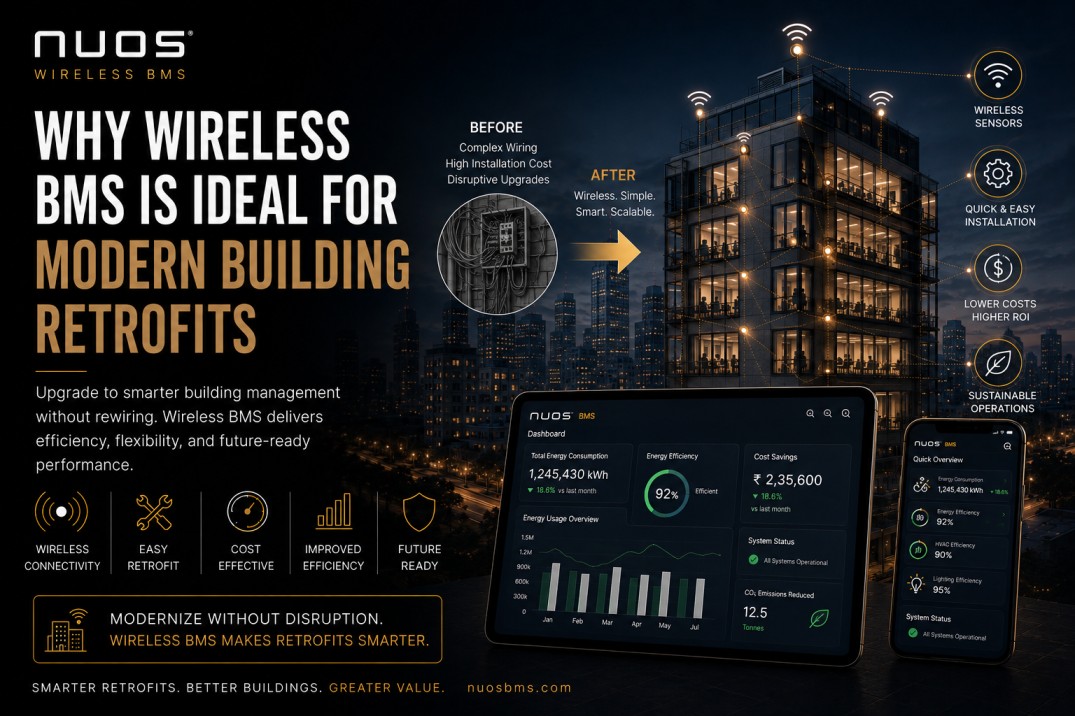
Energy efficiency has become a major priority for modern commercial and industrial buildings. Rising energy costs and growing sustainability goals are encouraging businesses to find smarter ways to monitor and control building operations. A Wireless Building Management System (BMS) provides an effective solution by connecting building systems and enabling intelligent, automated control. NUOS BMS helps organizations create more efficient buildings through wireless connectivity, real-time monitoring, and smart automation.
Real-Time Monitoring for Better Energy Control
A wireless BMS uses connected sensors to collect real-time information about temperature, occupancy, energy consumption, and equipment performance. Facility managers can view this information through a centralized platform and identify areas where energy is being wasted.
With accurate data available in real time, building operators can make faster decisions and adjust systems according to actual requirements rather than relying on fixed schedules.
Smarter HVAC Management
Heating, ventilation, and air conditioning systems can account for a significant portion of a building’s energy consumption. Wireless BMS technology allows HVAC systems to respond to occupancy levels, temperature changes, and operating conditions.
NUOS BMS can help automate these adjustments, reducing unnecessary heating and cooling while maintaining a comfortable indoor environment.
Intelligent Lighting Automation
Lighting is another important area for energy savings. Wireless occupancy sensors can detect whether rooms or spaces are being used and allow lighting systems to operate accordingly.
Lights can be switched off or adjusted in areas that are unoccupied, helping businesses reduce electricity consumption without requiring constant manual control.
Predictive Maintenance Supports Efficiency
Poorly performing equipment can consume more energy than necessary. Wireless BMS can continuously monitor equipment and identify unusual performance patterns.
Early detection allows maintenance teams to investigate issues before they result in major failures or increased energy consumption. This can improve equipment performance and extend asset life.
Supporting Sustainable Buildings
Energy efficiency is closely connected to sustainable building management. By combining automation, monitoring, and data-driven insights, wireless BMS technology helps businesses reduce energy waste and improve operational performance.
Conclusion
Wireless BMS is becoming an important technology for businesses looking to improve energy efficiency. With smart sensors, real-time monitoring, automated controls, and intelligent insights, NUOS BMS helps transform conventional facilities into smarter and more sustainable buildings.